
“Good Intentions Don’t Make a Marriage!” My Mother-in-Law Declared, Then Announced That She Was Giving My Inherited Apartment to Her Grandson. But I Had a Very Different Surprise Prepared for the Wedding…
“Good intentions don’t make a marriage!” Raisa Stepanovna declared, raising her glass of cherry liqueur as though she were officially opening a family meeting. “My little Egor is getting married on August twenty-ninth! We’ve already booked the restaurant by the river.”
“Congratulations!” Zhenya smiled. “It’s about time.”
“And the newlyweds will be living in Bragino. They’ll get your apartment. You don’t need it anyway.”
Zhenya was in the middle of cutting a cabbage roll. Her knife stopped, and the cabbage leaf slowly unfolded on her plate.
The phone resting in her lap vibrated briefly. She didn’t need to look at it. She knew exactly what the notification said.
“Transfer successful. Polina R. – 15,000 rubles.”
It was the seventeenth of the month. Another regular monthly transfer, which she had been making every month since the spring before last.
“Raisa Stepanovna, someone is still living in that apartment. Zoya’s rental agreement runs until the end of October.”
“Then she can move out earlier. She’s a grown woman. I’m sure she can find somewhere else.”
“Besides, I use the rental income to help Polina pay her mortgage.”
“Polina has a husband! Let him pay! Egor, on the other hand, is twenty-five. He needs to start a family. We’re not strangers to one another!”
Zhenya’s sister-in-law, Zhanna, pushed the sour cream closer to her, wearing an expression that suggested she was personally trying to save the family peace.
“Mama, don’t push her,” she interrupted. “Let Zhenya think about it.”
“What is there to think about? We’ll give it to them for three years, until they get back on their feet. They’ll just pay the utilities. I’m not a monster!”
Meanwhile, Gena continued eating without the slightest concern. He was studying a jar of pickles so intently that anyone would have thought the championship final was being broadcast inside it.
The one-room apartment in Bragino had belonged to Zhenya’s mother. It was thirty-four square meters, on the fifth floor of a panel apartment building, with a courtyard full of poplar trees beneath the windows.
Her mother had died in November 2023. For the following six months, Zhenya had traveled there every weekend. She cleaned the apartment, sorted through the wardrobes, and even wallpapered the kitchen herself.
In the spring of 2024, she began renting it out. The monthly rent was 21,000 rubles, with utilities paid separately by the tenant. Everything was legal and covered by a rental agreement, and Zhenya paid her taxes as a self-employed individual.
Every month, she transferred 15,000 rubles from that income to her daughter in Saint Petersburg.
Polina’s mortgage payment was 46,000 rubles. She also had a one-and-a-half-year-old son, Lyova, and was currently staying home with him.
Zhenya put the remaining money into a savings account she had simply named “Renovations.” There was always something in an apartment that eventually needed repairing.
“No,” she finally said firmly. “I’m not giving away my apartment.”
Her mother-in-law smiled patiently, just as she used to at parents’ meetings thirty years earlier.
“Don’t get upset so quickly! Gena still keeps the spare key in the sideboard drawer, doesn’t he? I remember. Zhanna and I will go over sometime this week and see what needs a little repainting.”
“You’re not going anywhere.”
“Mama, we’ll talk about this later,” Gena muttered, still staring at the pickle jar.
On the drive home, he remained silent for a long time. Then, at a red light on Moskovsky Avenue, he finally spoke.
“You immediately went on the attack. My mother is seventy-eight. I think she may have already promised the apartment to Alla, too.”
“Which Alla?”
“The bride’s mother. My mother says they’re respectable people. They own three flower shops.”
When they got home, Zhenya’s first move was to pull open the sideboard drawer. The spare key was still there, inside Gena’s watch box.
She picked it up, examined it for a moment, and put it back.
She couldn’t exactly start hiding keys from her own husband.
On Thursday evening, June eleventh, at around half past ten, her phone rang.
It was Zoya.
“Yevgeniya Olegovna, I’m sorry to call so late. Did your mother-in-law visit you today? An older woman wearing a hat, accompanied by a younger woman and a girl?”
“When?”
“Today, around six. They opened the door with their own key. I had just stepped out of the shower when I saw them in my kitchen. They were walking around with a measuring tape!”
Zhenya sat down on the little stool in the hallway, directly in front of Gena’s sneakers.
“What did they say?”
“They told me I had to move out in August. Then they asked whether the refrigerator belonged to me or came with the apartment.” Zoya paused. “Actually, I was planning to move anyway, just in November. My mother’s health has deteriorated badly in Tutayev, and I want to go and live near her. But I need this apartment until October thirty-first. My workplace is nearby, too.”
“You can stay until October thirty-first. I promise.”
“The young girl photographed everything. She said they needed a white, glossy kitchen with a corner sink.”
Zhenya stood up and opened the drawer again.
The watch box was empty.
Gena was in the living room watching football. Zhenya walked over and stood directly in front of the television.
“Where’s the key?”
“What key? The spare one?” Gena saw her expression and immediately reached for the remote. “My mother asked for it. She said she only wanted to look at the curtains. I didn’t think she would actually meet the tenant.”
“And what did you think? That she could start rearranging my apartment without my permission?”
“Zhenya, don’t get worked up! She’ll give it back.”
“Call her. Right now!”
Gena put the phone on speaker. Raisa Stepanovna answered almost immediately.
“Gena, darling, I must have put it somewhere. I’ll find it. Is Zhenya upset? We only wanted to measure the curtains!”
The following Saturday, Zhenya went to Bragino with a locksmith she had called from a nearby hardware store.
It took twenty minutes to replace the lock cylinder. The total cost, including labor, was 2,800 rubles.
She gave Zoya two new keys and slipped the third into her wallet beside her loose change.
“Yevgeniya Olegovna,” Zoya said as she walked her to the elevator, “may I ask who that young girl was?”
“My husband’s nephew’s fiancée.”
“I see. That explains it. Before leaving, she also said her mother was going to order the kitchen furniture by the end of summer. Apparently, they already had all the measurements.”
Zhenya said nothing.
The tailoring workshop on Svoboda Street occupied a semi-basement room with two tiny windows whose lower edges were level with the pavement.
Zhenya had worked there for twenty-eight years. She had started in her mid-twenties, and by now she could tell the weather, the season, and even the current cost of living just by looking at a passerby’s shoes.
Rimma, a sixty-three-year-old tailor famous throughout the city for her trouser alterations, listened to the entire story over the hum of the overlock machine. She didn’t make a single mistake in her stitching.
“Zhenka, let me make sure I understand. Your mother-in-law gave your apartment to her grandson?”
“She only promised it.”
“Without asking you?”
“She didn’t manage to get it from me.”
“What a generous woman! It’s easy to give away someone else’s money.” Rimma bit off the thread. “Remember that customer from 1998? She asked me to sew something for free and said she’d probably praise me someday. Your mother-in-law is exactly like that. Only she wears a hat.”
“She keeps saying, ‘Good intentions don’t make a marriage.’”
“Of course,” Rimma replied. “Especially when the fabric belongs to someone else.”
At three that afternoon, Olga Semyonovna arrived for a fitting. She was a respected notary who had ordered a dark blue crepe dress for her husband’s birthday.
While Zhenya knelt to pin the hem and held a few pins between her lips, the entire story somehow spilled out.
The notary listened carefully before answering in a calm voice.
“Property acquired through inheritance is your separate property, not marital property, even if you’ve been married for forty years. Nobody can move into it or register their residence there without your permission. Anyone can promise an apartment, but only its legal owner can give it away. And regarding your tenant: even you cannot evict her before the rental agreement expires without her consent, unless there is a legal reason, such as failure to pay rent or damage to the property.”
Then she turned toward the mirror.
“Isn’t it a little too loose on the sides?”
“I’ll take another half-centimeter in,” Zhenya replied.
That evening, Polina called.
“Mum, Grandma Raisa called me. She was crying.”
“She didn’t cry to me.”
“Mum, please, just give them the apartment! Stas says he’ll get a bonus in the autumn, and I’ll somehow manage, too.”
“In March, you were counting the cost of every diaper.”
“Exactly! But we’ll figure something out. I don’t want the whole family fighting because of me. Because of those fifteen thousand rubles. Just stop sending me money. Stas and I will manage somehow.”
“Polina…”
“Mum, Lyova has woken up. Please think about it, okay?”
Zhenya ended the call, turned her phone face down, and returned to her worktable.
A piece of expensive silk lining lay across the cutting surface. It cost 680 rubles per meter.
Zhenya placed the pattern on it, traced around it with tailor’s chalk, and then cut the fabric four centimeters shorter than necessary.
She stood there for a long time, holding the scissors.
They had belonged to her mother. They were German-made, with one handle repaired using electrical tape.
The following morning, Rimma picked up the ruined piece of silk between two fingers.
“What on earth is this?”
“Scrap. I ruined it.”
“We’ve worked side by side for twenty years, and I’ve never seen you do anything like this.”
Rimma folded the fabric and placed it on a shelf.
“It’ll still be useful for pockets. And tell your mother-in-law I’m charging her for the material. Six hundred and eighty rubles per meter.”
Perhaps the mother-in-law sensed that a storm was approaching, because she called that very evening.
“Zhenyechka, what color ribbon should we tie to the key? Red or gold? We need it for the wedding. I chose red. It brings good luck!”
Before Zhenya could answer, she hung up.
In July, on a Saturday, Zhanna showed up at their home. She brought a cake from a pastry shop and began waving her brand-new artificial nails around before she had even taken off her coat.
“Zhenya, try to understand! Vika comes from a very good family. Her mother, Alla Vitalyevna, has her own business, and her father drives his own car. They own three flower shops. What are we compared to them? We look like poor relatives!”
“But you’re still their relatives. What does that have to do with my apartment?”
“Oh, there you go again!”
Zhanna lifted the cake lid as though she were about to produce the final piece of evidence.
“My mother has been promising Egor his entire life that she would help him get an apartment. She’s been saying it since he was in vocational school!”
“And did she help him?”
Zhanna raised an eyebrow and reached for a knife.
“Would you like a piece with a rose on it or without?”
Gena walked his sister to the bus stop.
Forty minutes later, he returned and sat on the edge of the bathtub while Zhenya was brushing her teeth.
“Zhenya, what if they stayed with us instead? Just for a year. They could pay the utilities. And I’d transfer the fifteen thousand rubles to Polina every month myself.”
“With what money, Gena? Your salary of 82,000 rubles, from which 18,000 goes toward the car?”
“I’d take on extra work.”
“You work at the factory on Saturdays and repair things in the garage on Sundays. When exactly do you plan to work more? In your sleep?”
Gena picked at the grout between the bathroom tiles with his fingernail.
“I just don’t want there to be a scene at the wedding…”
“Neither do I.”
On Sunday, Zhenya sat down at the kitchen table, took out her calculator and opened the old notebook in which she had been recording customers’ measurements since the 1990s.
At the top of a blank page, she wrote:
“Raisa Stepanovna’s Gift.”
Monthly rent: 21,000 rubles. Twelve months: 252,000 rubles annually.
Of that amount, 180,000 went to Polina.
Below it, she wrote another heading:
“My Gift.”
The apartment would be vacant on October thirty-first. The rental agreement with Egor would begin on November first and run until September thirtieth, for eleven months.
Monthly rent: 15,000 rubles, plus utilities.
Exactly the amount she sent to Polina.
The first month would be free. That would be her and Gena’s wedding gift.
Vika would also be listed in the agreement as a permanent resident. Nobody else could move in without the owner’s permission.
She spent the longest time thinking about clause seven:
“The tenant is entitled to install their own kitchen furniture, which they may remove when the rental agreement expires.”
She downloaded a standard rental agreement from the internet, modified it to suit her needs, printed two copies, signed them, and placed them in an envelope.
Rimma leaned over her shoulder.
“What’s this seventh clause for?”
“Because they’ve already ordered the kitchen.”
“How do you know?”
“That girl was walking around someone else’s apartment with a measuring tape, talking about kitchen cabinets. People measure like that for furniture, not curtains.”
Rimma simply hummed and returned to her trousers.
Two days before the wedding, Gena noticed the envelope in Zhenya’s bag.
“What’s that?”
“A gift.”
“What kind of gift?”
“One that nobody can call defective.”
On the morning of August twenty-ninth, Gena had already retied his tie for the third time in front of the mirror.
“Zhenya, my mother said she’s going to make a special toast today.”
“I know,” his wife replied. “And take that tie off. Wear the blue one.”
The restaurant stood on the banks of the Kotorosl River.
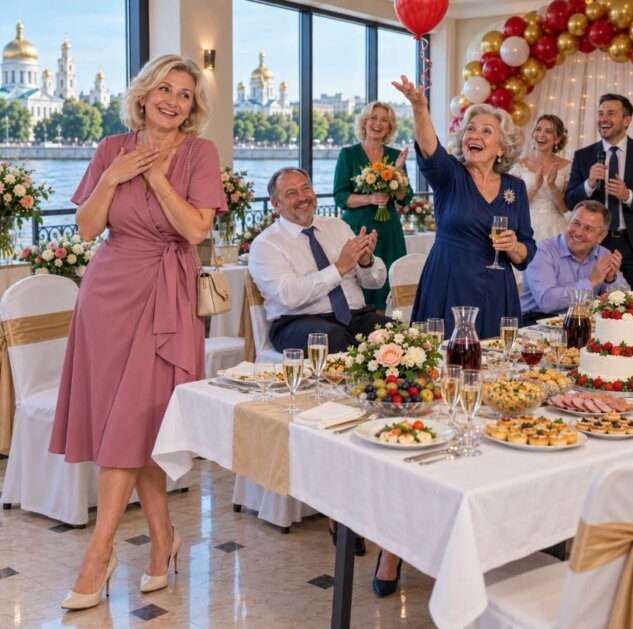
There were white chairs decorated with enormous bows, a balloon arch, fifty-four guests, and a master of ceremonies named Edik who laughed loudly at every one of his own jokes into the microphone to make sure nobody missed the punchline.
Vika looked radiant in her off-the-shoulder wedding dress and kept straightening Egor’s jacket sleeve. Egor was tall, slightly nervous, and wearing a suit one size too large. He smiled like someone who hadn’t eaten a single bite since morning.
Alla Vitalyevna wore an emerald-green dress and spoke even louder than the master of ceremonies. Her husband, Vadim Ilyich, was a heavyset, quiet man. He rarely spoke, but whenever he did, even the people at neighboring tables stopped chewing.
“Are you Yevgeniya?” Alla Vitalyevna leaned toward her. “Oh, we are so grateful to you! I told Vika how lucky she was to be joining such a wonderful family.”
“There isn’t anything to be grateful for yet,” Zhenya replied.
“Oh, don’t say that!”
After the main course, Edik shouted into the microphone:
“And now, let’s welcome the wisest person of the evening! The groom’s grandmother, Raisa Stepanovna!”
Her mother-in-law stood up.
She wore a burgundy dress, an elegant brooch, and a freshly styled hairstyle. In one hand, she held her glass. In the other, she held a key decorated with a thick red satin ribbon.
“My dear children!” she began ceremoniously. “I have always said that good intentions don’t make a marriage!”
The guests laughed, and Edik laughed louder than anyone.
“And so that these young people have somewhere to begin their life together, on behalf of our family—that is, myself, Gena, and Zhenya…”
She raised the key high above her head.
“I give you the apartment in Bragino! May you live there happily, have many children, and never forget us!”
A storm of applause erupted. Even the balloons tied to the decorative arch seemed to tremble. Vika’s friends squealed with excitement, and one guest exclaimed loudly:
“Now that’s what I call a mother-in-law! I wish everyone had a grandmother like that!”
“We’ve already ordered the kitchen, too, Raisa Stepanovna!” Alla Vitalyevna shouted as she stood up. “Exactly according to your measurements! It cost 260,000 rubles, and they’re installing it on September fifth!”
Vadim Ilyich put down his fork.
“Alla, I told you not to order kitchen furniture for someone else’s property.”
“Vadik, don’t start now!”
Raisa Stepanovna handed the key to Vika and kissed her on both cheeks.
The bride pressed the key against her chest and began to cry. Her mascara slowly started running.
That was when Zhenya took the envelope from her handbag and walked toward the newlyweds’ table.
She didn’t hurry.
Gena watched her back.
“Egor, Vika, congratulations!” she said, placing the envelope in front of Egor. “This contains 20,000 rubles from us, along with a rental agreement in two copies. You can read it carefully at home.”
“What agreement?” Alla Vitalyevna appeared beside them so quickly that it seemed she had been waiting for this exact moment.
“A rental agreement. The apartment in Bragino belongs to me. I inherited it from my mother. Someone is still living there under a valid rental agreement until October thirty-first. We replaced the old lock in June, so that key won’t open anything anymore.”
Then she continued:
“But starting November first, you can move in. The agreement is for eleven months. The rent is 15,000 rubles a month, plus utilities. The first month is free. There is also a separate clause about installing the kitchen furniture.”
“Rent?!” Alla Vitalyevna repeated the word as though she had just heard something deeply offensive.
“Yes. Apartment rental.”
“Yevgeniya, are you serious? In front of everyone? You could simply give the apartment to the young couple for free! Why is it so difficult for you to help your own family?”
“I have a family, too,” Zhenya replied. “I have a daughter who needs to pay her mortgage. That fifteen thousand rubles goes to her.”
Raisa Stepanovna stood beside the wedding cake. The color slowly drained from her face.
“Gena!” she shouted. “Say something to her!”
Gena put down his fork, straightened his blue tie, and stood up.
“Mama, the apartment belongs to Zhenya. You asked me for the key, saying you only wanted to look at the curtains.”
“Are you humiliating me in front of everyone?!”
“You humiliated yourself when you gave away someone else’s apartment in front of all the guests,” Zhenya said quietly.
Zhanna stepped forward from behind and grabbed her mother’s arm.
“Of course! Zhenya is such a generous benefactor. For fifteen thousand a month!”
Vadim Ilyich spoke without looking up from his plate.
“And how much does it cost to rent an apartment in the neighboring building? As far as I know, it’s twenty-two thousand.”
“Vadik!”
“I was just making an observation.”
Edik sensed that the atmosphere was heading in a dangerous direction, so he quickly shouted into the microphone:
“And now, let’s welcome the couple who have been married the longest on the groom’s side! Everyone to the dance floor!”
The music started.
Zhenya returned to her seat. Gena poured her a glass of juice, but held the jug for so long that he seemed to have forgotten what he had intended to do with it.
At the newlyweds’ table, Egor was turning the red-ribboned key between his fingers.
Then he spoke quietly.
“Grandma… where is that money? The money you were saving for me to buy an apartment?”
Zhenya heard him only because she was sitting nearby.
Raisa Stepanovna turned away and reached for the cake knife.
On Monday, August thirty-first, at half past nine in the morning, Egor appeared at the tailoring workshop.
He was wearing a work jacket with the logo of an auto repair shop. Zhenya recognized his shoes through the window before he even came inside.
“Aunt Zhenya, could we talk?”
Rimma silently put the kettle on and pulled a chair toward him.
“I signed it,” Egor said, placing one copy of the agreement on the table. “I showed it to Vika, too. She’s fine with it. But I’d actually like to pay twenty-one thousand, like Zoya did. I want to pay you fairly.”
“It will be fifteen thousand.”
“I don’t want a discount.”
“This isn’t a discount. It’s exactly the amount I transfer to Polina. Not one ruble more, not one ruble less.”
Egor nodded and wrapped both hands around his mug.
“Grandma has been telling me since I was seventeen that she’d buy me an apartment. She saved money from her pension, then even sold Grandpa’s garage. There were 700,000 rubles in her bank deposit. I saw the statement when I came home from military service.”
“And where is that money now?”
Egor smiled bitterly.
“My mother used it to pay off her debts. Microloans, two credit cards. With interest, it came to 640,000 rubles. The debt collectors even started calling Grandma at home. Two years ago, Grandma paid everything off, but she never told anyone. Not even Uncle Gena.”
Rimma placed the plate of biscuits on the table. This time, she didn’t interrupt.
“In the spring, when our families met, Alla Vitalyevna asked where Vika and I would live. Grandma said we had our own apartment in Bragino. She was ashamed to admit that my money had disappeared because of my mother Zhanna’s debts.”
“And what did they tell you?”
“My mother said Uncle Gena had promised us the apartment years ago and that you knew about it, too. I believed her. I was an idiot.”
“You’re not an idiot,” Zhenya said. “You’re twenty-five. They’re the ones who have had much more practice lying.”
Rimma joined in.
“You have a good aunt, Egor. Appreciate her! She’s even capable of turning expensive silk into pockets when it comes to the truth.”
Egor didn’t quite understand the remark, but he smiled.
Before leaving, he turned around.
“Alla Vitalyevna called yesterday. They’ll keep the kitchen in storage until November for 2,000 rubles a month. Vadim Ilyich said he’ll pay the storage costs, but he told Alla never to order anything again without seeing the property documents first.”
After the door closed behind him, Rimma asked:
“Does Gena know what happened to that 700,000?”
“He’ll find out tonight.”
Gena went to visit his mother after his shift and didn’t return home until around eleven that night.
He sat down in the kitchen without even taking off his shoes.
“She never told me anything. She kept it secret for two whole years. She said that if she’d told you, you would have gone straight after Zhanna.”
“Me?”
“Exactly what I asked her.” Gena buried his face in his hands. “Zhenya, I’m never giving anyone a key again. Not to anything. Not even the garage.”
“You can give them the garage key,” Zhenya said. “All you’ve got in there is your winter tires.”
On Saturday, October thirty-first, Zoya moved out of the apartment.
She left everything clean, placed the keys on the little dresser, and stuck a note to the refrigerator:
“Thank you for everything! The radiator in the room leaks at the bottom. Please call a plumber. Zoya.”
On November fourth, a public holiday, the new kitchen furniture was installed.
Vadim Ilyich brought the installers himself. Gena and Egor carried the boxes up to the fifth floor together.
Meanwhile, Zhenya called a plumber to repair the radiator. It cost 2,300 rubles, which she paid from her savings account named “Renovations.”
Vika excitedly ran around the apartment, photographing every single white, glossy kitchen cabinet.
Alla Vitalyevna arrived around noon carrying a large dish of cabbage pie.
“Yevgeniya, I’d like to apologize. I treated you unfairly at the wedding. I also told Raisa Stepanovna afterward that next time we’ll ask to see the property documents before making any wedding toasts!”
“And what did she say?”
“She called me a businesswoman.” Alla Vitalyevna laughed. “Well, I suppose I am. But at least the kitchen fits perfectly!”
Raisa Stepanovna called on Sunday morning, November twenty-second.
They hadn’t spoken to each other for nearly three months. The mother-in-law had only occasionally sent messages through Gena, saying things like, “Tell your wife my blood pressure is 160.”
“Zhenya…” she began in an unusually quiet voice. “Have you seen Zhanna lately?”
“At the wedding.”
“She has now come up with the idea of selling my two-room apartment. She has debts again. Another credit card, apparently. She says I should sell it, buy a smaller apartment in Harshegy, and use the remaining money to settle her debts. She even said the utility bills would be lower. According to her, it’s a good deal.”
Zhenya turned off the kettle.
“And what did you tell her?”
“I said no! The apartment is in my name. As long as I’m alive, nobody is coming here with a measuring tape and renovation plans!” She fell silent. “Why aren’t you saying anything? Are you laughing at me?”
“No, Raisa Stepanovna. You did the right thing.”
“Zhanna got offended. She slammed the door. She said I’d become greedy because of you.”
“Then tell her your favorite saying: good intentions don’t make a marriage.”
Zhenya picked up her mother’s old scissors from the table. One of the handles was still held together with electrical tape. She placed them back in the drawer.
“In my workshop, if someone cuts fabric to another person’s measurements without permission, it’s considered defective. You don’t give it away as a gift. You have to cut it again.”
For a long time, all Zhenya could hear from the other end of the phone was the ticking of a clock.
“Will you come over for cabbage rolls on Sunday?” her mother-in-law finally asked. “Tell Gena to bring some horseradish. We’ve run out.”
On Tuesday morning, December first, at eight o’clock, Zhenya’s phone vibrated briefly on the kitchen table.
“Incoming transfer: 15,000 rubles. Egor V. Description: December rent.”
Zhenya had already canceled the automatic transfer to Polina in November.
Now she manually transferred the same amount to her daughter from the “Renovations” savings account.
In the payment description, she wrote:
“Mortgage payment, December.”
A minute later, a reply arrived.
“Mum, thank you! Lyova said ‘Grandma’ yesterday for the first time. He looked at your photograph and said it. I had to look at him twice to make sure I’d heard correctly.”
Gena came out of the bathroom, wiped his neck with a towel, and placed a key beside the phone.
It was the old key, the one removed when the lock cylinder had been replaced.
The red satin ribbon was still attached. The bow was a little crumpled, but it hadn’t come undone.
“Egor gave it back. He said it belongs with the landlady.”
Zhenya untied the ribbon, smoothed it with her palm, and put it aside. Rimma was making a veil for her niece’s granddaughter on Friday and needed something red to bring good luck.
She dropped the key into an old metal candy tin where her mother’s remaining buttons were kept.
The apartment remained hers. Her daughter continued receiving the help she needed. And the newlyweds received something they genuinely needed: an honest chance to build a new life through their own efforts.
And perhaps Raisa Stepanovna had finally understood that you cannot be generous with someone else’s property.

